Coming Soon !!! Transit Three , BOok 1 of the Terminal Solution Series

Spacecraft
Futuristic Visions
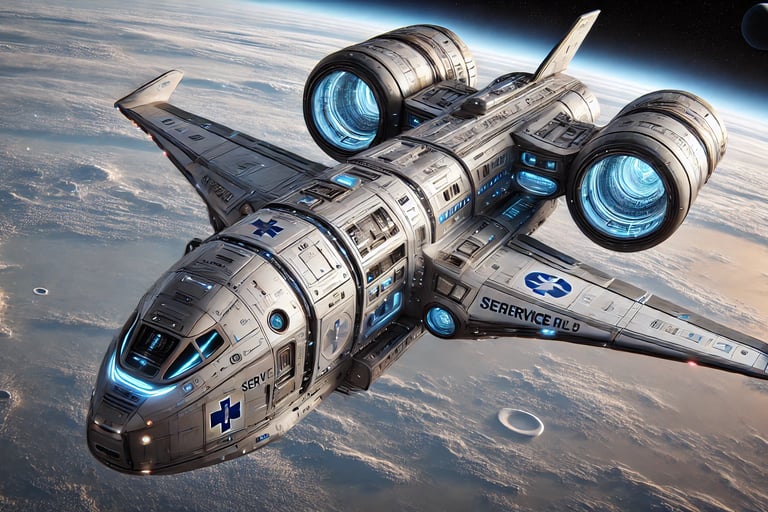
Designing a spacecraft to maneuver in space like an aircraft maneuvers in atmosphere is a challenging task due to the fundamental differences between atmosphere and space. In space, there is no atmosphere to provide lift or resistance, no aerodynamic forces to rely on, and no gravity to maintain orientation. As such, spacecraft must rely entirely on propulsion systems, reaction control systems, and advanced guidance technology for maneuvering.
Propulsion Systems: To maneuver like an aircraft a spacecraft would require high-thrust propulsion for major directional changes and low-thrust systems for fine adjustments. High thrust: traditional chemical rockets, would act as the crafts primary propulsion, much like an Aircraft's engine.
Low-thrust propulsion used for fine adjustment and attitude control, might incorporate xenon Ion or other charged particle thrusters, Hall-effect thrusters, or even plasma thrusters. These would be used for long duration acceleration, or minor trajectory corrections.
Reaction Control Systems: To achieve aircraft-like maneuverability, a spacecraft requires a Reaction Control System (RCS) to manage pitch, yaw, and roll in the absence of atmospheric control surfaces.
Reaction control thrusters (RCS jets) provide short bursts of force for quick attitude adjustments, replacing the function of an aircraft’s ailerons, rudder, and elevators.
Gyroscopic systems (reaction wheels, momentum wheels, and control moment gyroscopes) allow for fuel-efficient, continuous orientation adjustments but do not generate thrust or handle abrupt trajectory changes.
Together, these systems enable precise spacecraft maneuvering in microgravity.
Structural Considerations: Movable appendages, similar to ailerons might be useful, not to generate aerodynamic lift, rather to control inertia and reduce the complexity of stability and control.
Control Systems and AI: Maneuvering in space like an aircraft would undoubtedly require a sophisticated control system. AI would provide real-time calculations to make the rapid calculations needed for aircraft-like maneuverability in space.
Energy Management: Due to high energy consumption, a maneuverable spacecraft would require a robust power system and sophisticated heat dissipation.
Wings and Tails: The presence of wings and tails would indicate that the spacecraft is also expected to fly in atmosphere. A craft like this would possess all of the spacecraft attributes mentioned above as well as standard aircraft structural components to survive traditional aerodynamic loads.
The LaGrange Points
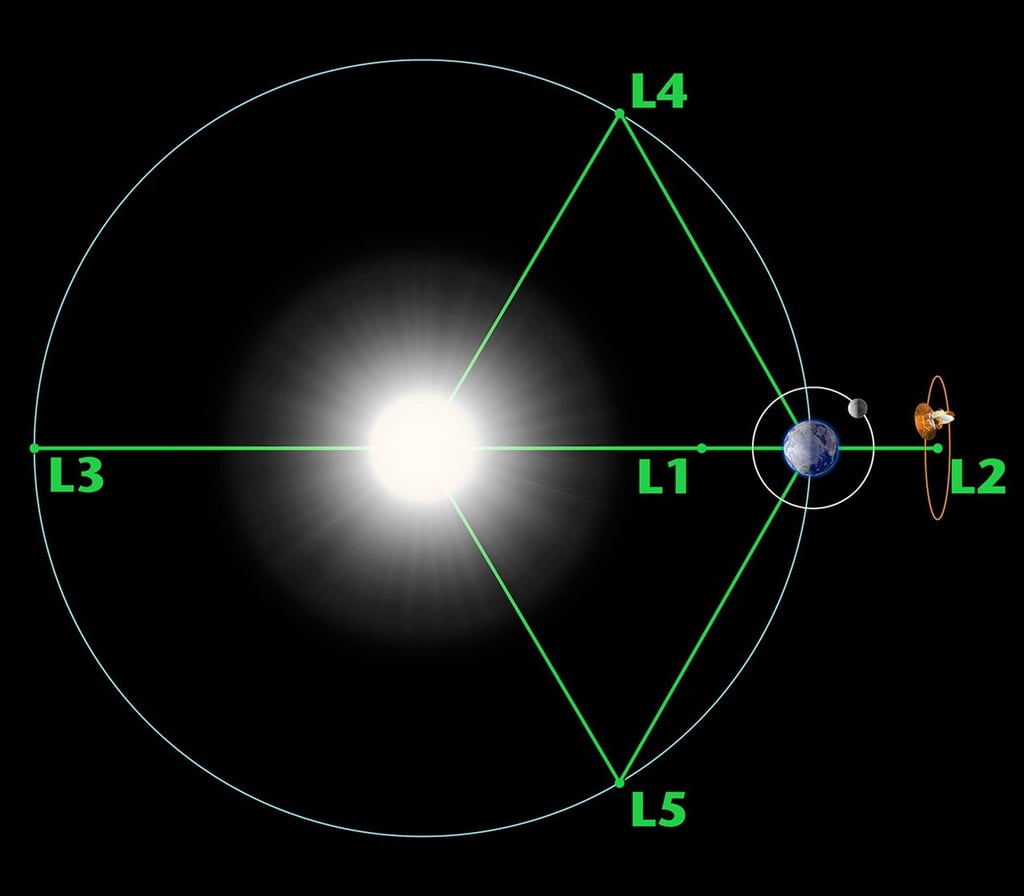
A dime-store tour of the Lagrange points as told by a science fiction writer and not an astrophysicist, so, in the immortal words of Ronald Reagan, “Trust, but Verify.”
There are five Lagrange points associated with any two massive bodies in orbit. Named after the mathematician Joseph-Louis Lagrange, who built upon the earlier work of Leonhard Euler, they are referred to as L1 through L5.
At each of these points, gravity and orbital motion combine to create a special kind of equilibrium. The best example is L1, located between the Earth and the Sun. There, the combined effects of the Sun’s gravity, Earth’s gravity, and the orbital motion of the Earth-Sun system allow a spacecraft to remain fixed relative to Earth. A spacecraft placed at L1 appears to hover between the two bodies—not because gravity disappears, but because it is moving in just the right way to remain with Earth as both orbit the Sun.
The Lagrange points are extraordinary places to station scientific observatories and spacecraft because they require relatively little energy to maintain their positions.
In Transit Three, the North Star Satellite (NSS) resides at L4, where it coordinates the station-keeping of the ten thousand satellites that comprise the WinterField.
Why L4?
Unlike L1, L2, and L3, the L4 location is not balanced on top of a gravitational hill. It sits within a broad gravitational well.
What does that mean?
Imagine placing a marble on top of a hill. The slightest nudge sends it rolling away, and climbing back requires energy. That's how L1, L2, and L3 behave. They are stable only as long as their position is constantly corrected.
L4 is different.
Its stability isn't created by gravity alone. It emerges from the combination of Earth's gravity, the Sun's gravity, and the orbital motion of the entire Earth-Sun system. L4 is perpetually falling around the Sun along with Earth, maintaining a constant sixty-degree lead in Earth's orbit.
If a spacecraft at L4 is nudged slightly toward the Sun, it falls into a slightly lower solar orbit and accelerates. That increase in speed causes it to drift ahead of its equilibrium position, where the combined gravitational influence of the Earth and Sun gradually steers it back toward L4. If it drifts slightly away from the Sun, the opposite occurs: it enters a slightly higher orbit, slows, falls behind, and is once again guided back toward equilibrium. Rather than tumbling off a hill, a disturbed spacecraft naturally traces a slow looping path around L4 before settling back toward equilibrium. Engineers call these tadpole orbits. They are the signature of one of nature's most remarkable examples of orbital stability. As long as the spacecraft hasn’t drifted too far, it need not try to return to L4; the Earth-Sun system is naturally guiding it back there.
A little on the history behind the Lagrange points:
One historical misconception is that Lagrange discovered all five Lagrange points. He didn't.
In 1687, Isaac Newton published the laws of motion and universal gravitation. For the first time, astronomers could mathematically predict the motion of two bodies interacting through gravity—the famous two-body problem. Whether describing an apple falling from a tree or the Earth orbiting the Sun, the same universal law applied.
Introduce a third body, however, and everything becomes dramatically more complicated. Each object continually alters the motion of the other two, producing a system that, in general, cannot be solved with a single equation. This became known as the three-body problem.
Nearly a century later, Leonhard Euler discovered that there are three special locations along the line connecting any two massive orbiting bodies where a third, much smaller object can remain fixed relative to the other two. Today we call these L1, L2, and L3.
A few years later, Joseph-Louis Lagrange found two additional equilibrium points, L4 and L5, located sixty degrees ahead of and behind the smaller orbiting body. More importantly, he proved that these triangular equilibrium solutions exist for any pair of qualifying orbiting bodies (sufficiently large masses).
Lagrange had not solved the three-body problem in its entirety. But he did discover one of its rare “exact solutions”, a beautiful exception to a problem that still challenges mathematicians and physicists more than 250 years later.
Sources and Further Reading
The science behind the Lagrange points is based on centuries of effort in astronomy and orbital mechanics. If you'd like to learn more, these are excellent places to start:
I would start here:
NASA – Articles on Lagrange points, orbital mechanics, and the James Webb Space Telescope.
Jet Propulsion Laboratory (JPL) – Easy-to-understand articles on spacecraft navigation and celestial mechanics.
Ready to go a little deeper?
European Space Agency (ESA) – Educational resources on orbital dynamics and space missions.
If your drinking buddy is Neil deGrasse Tyson:
Isaac Newton – Principia Mathematica (1687), the work that introduced the laws of motion and universal gravitation.
Leonhard Euler – Original papers introducing the collinear equilibrium points (L1-L3).
Joseph-Louis Lagrange – Original papers introducing the triangular equilibrium points (L4 an L5)
Or, if you happen to be on the Battle Moon Clarion, just ask Q, he can probably explain this better than I can.
Explaining the WinterField
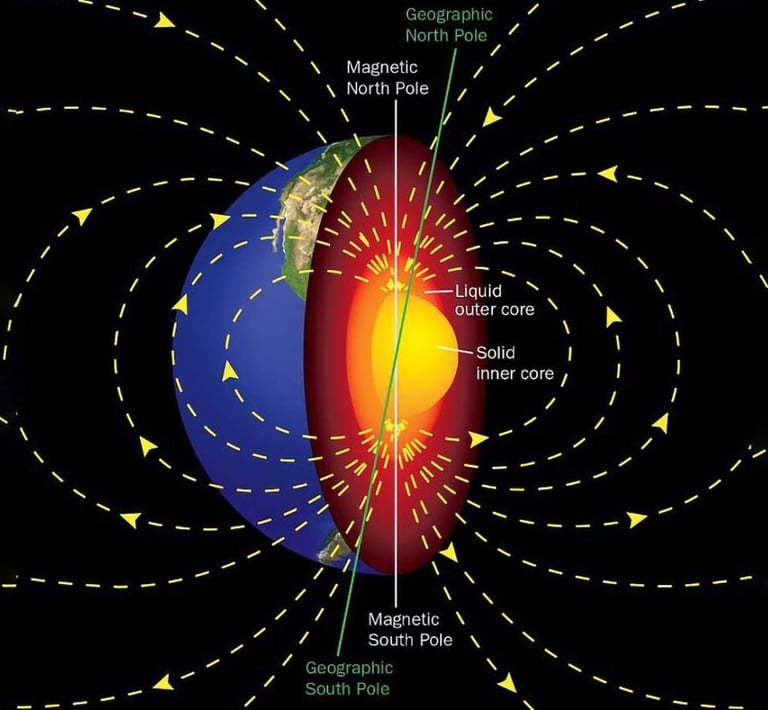


The Earth's Magnetic Field
The geo-dynamo is the process that generates Earth's magnetic field, driven by the convection of electrically conducting liquid iron in the Earth's outer core.
Since its discovery in 1936, the rotation, speed, and direction of the inner core has been a topic of debate. But what seems to be overwhelmingly accepted is that it is slowing down. So slow in fact, that many scientists are predicting a reversal in its direction soon. But in geological terms, that could mean next year, or hundreds of thousands of years from now.
Transit Three opens with this concerning fact:
Earth's magnetic poles have flipped hundreds of times over the past 160 million years, each reversal accompanied by centuries of a weakened magnetic field. During these vulnerable periods, the planet is left increasingly exposed to harmful cosmic rays and solar radiation—forces capable of wreaking havoc on life and technology. The last recorded reversal, the Brunhes-Matuyama event, occurred roughly 780,000 years ago, leaving humanity 400,000 years overdue for the next inversion. As the clock ticks down, humanity faces the daunting reality of navigating uncharted territory, confronting levels of cosmic exposure humankind has never been required to weather.
Transit Three begins with the Earth facing a low-flow condition, a state where Earth can no longer produce the geo-dynamo necessary to generate the planet's protective magnetic field.
Life is threatened and technology destroyed by the unmitigated bombardment of cosmic energy. The world responds, dividing the population into three classes: Academics- the gifted, Subterraneans - the hard working, and the Homesteaders - the forgotten.
Humanities response to this extinction level event, the WinterField - humanities last hope.
The WinterField
In the story, Transit Three, humanity faces an extinction level event when the Earth enters a Stagnant Core State (SCS), a catastrophic condition where the planets core can no longer generate the planets magnetic field.
To combat this extinction level event, the Circumterrestrial Faraday Array (CFA) was launched. A 10,000-satellite constellation that cast a protective Faraday mesh around the planet. The system designed in Transit Three was not without issues, one of which, plunges the planet into an artificial ice age. Hence, the Circumterrestrial Faraday Array would forever be known as the WinterField.
In theory, a network of satellites could be designed to reduce cosmic radiation exposure on Earth, but the system would face significant challenges.
In the near future, humanity might have a few ways to deploy a protective shield around the plant. A few concepts might be:
1) Plasma Shielding: The use of Low-Earth-Orbit (LEO) satellites to emit ionized plasma clouds. This could provide localized protection, but the satellites would require continuous replenishment.
2) Physical absorption: This would require an extremely dense network of satellites, blanketing the planet with a radiation-absorbing material. The shear number of satellites and amount of material makes this approach highly unfeasible.
3) Electromagnetic shielding (The WinterField): This would require 10,000 to 100,000 satellites, each with equipped with strong magnetic field generators. In theory, this approach would deflect cosmic radiation similar to the way our Magnetosphere currently works. The quantity of satellites would be dependent on the size of each magnetic field generator and the percentage of coverage required.
Localized shielding is already in practice-such as for the space station and soon for Mars bound spacecraft. Could a system be scaled to a planetary system? Not today, but perhaps in the near future.
Smart Suit Technology
Smart Fabric
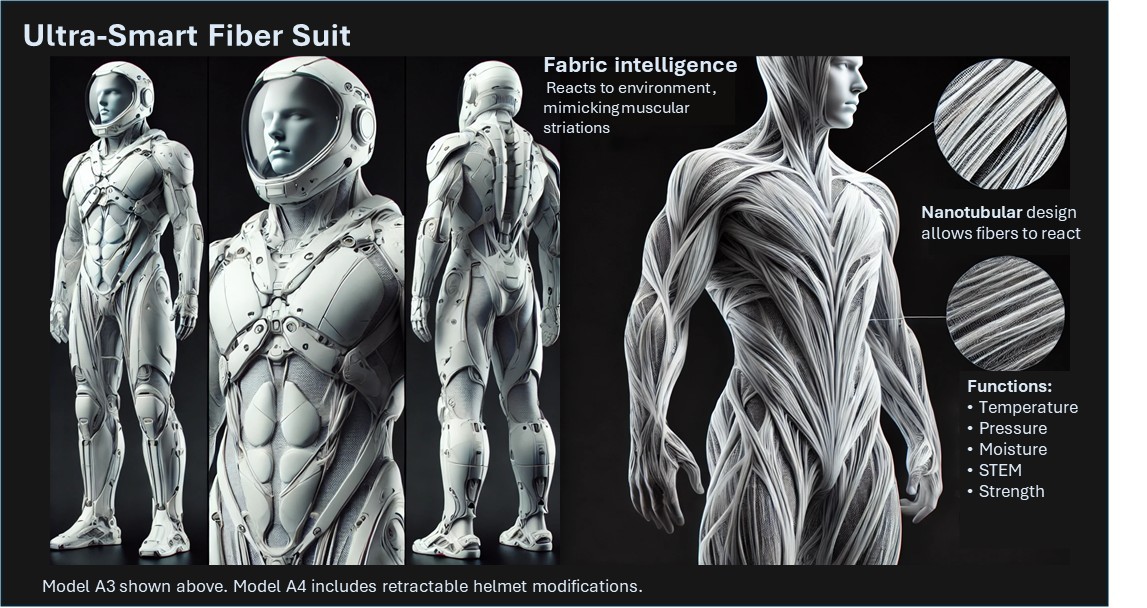
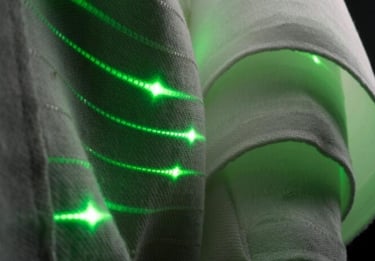
Smart fabrics are exactly that--smart. Also known as smart textiles or e-textiles, these fabrics can sense and respond to their environments. They are programmable, interactive, and can be tailored to support mission requirements. These materials can be passive or active, responding to external stimuli or analyzing data and pre-emptively adjusting for environmental trends.
Lower-level requirements like UV protective and sweat-wicking materials can be stand-alone (passive), while other, more complex textiles would require power sources to perform. The use of artificial intelligence, coupled with conductive fibers and micro-sensors will lead to very exciting developments in the near future.
In the novel, Transit Three, the crew's smart suits save their lives. The fibers go far beyond thermal protection, providing compression and tourniquet-like support to injured crewmates. Current technology monitors health and can provide camouflage by changing color to match the surrounding environment. With heavy investments in the industry, it is expected that the next decade will see advancements in self-healing and energy harvesting.
More information in this exciting field can be found at


Orbiting Web
Orbiting Wbe
Fiber@MIT Research
Genetics
You didn’t come this far to stop
DNA and Genetics
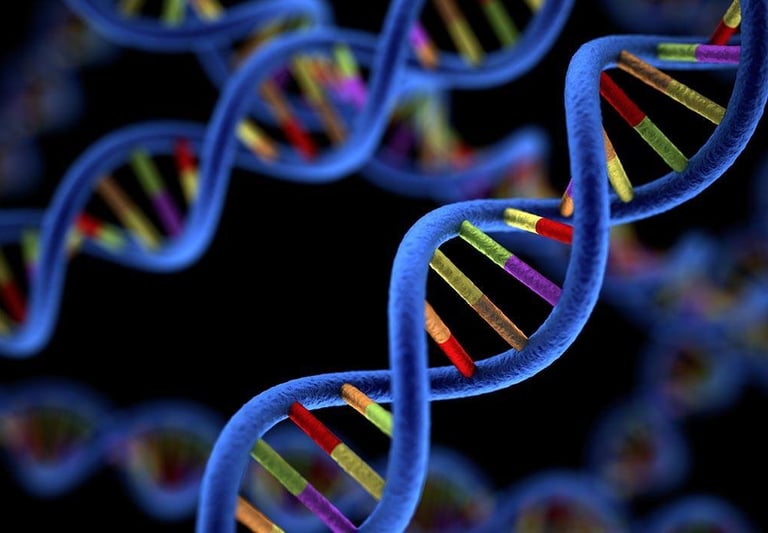
DNA, or deoxyribonucleic acid, is a molecule that contains the genetic blueprint for nearly all living organisms. It is typically found in a double stranded form made up up of 2 polynucleotide chains that coil around each other in the form of a double helix. Each nucleotide chain is made up of 4 nucleotides made up of 4 nitrogenous bases : adenine (A), cytosine (C), guanine (G), or thymine (T). These bases pair up in a very specific way with A always pairing with T and C always pairing with G.
Although it seems rather simple with only 4 different nucleotides, this specific sequence of bases over the span of billions of base pairs determines the hereditary traits passed from parents to to offspring. Each key component of hereditary information is organized into regions of DNA called genes. Long stretches of DNA and the genes are packaged into compact structures called chromosomes found in the nucleus of cells. DNA in these chromosome structures can replicate itself so that each cell in the organism will have an exact copy of its DNA after cell division. Humans typically have 23 pairs of chromosomes found in each cell nucleus totaling 46 with 22 pairs being non sex chromosomes and 1 pair being the sex chromosomes which determine biological sex (XX for female and XY for male).
The totality of an orgaisms genetic material is known as its genome. During the gene expression process these genes are transcribed into an intermediate molecule known as RNA or ribonucleic acid. There are a few different forms of RNA but the key hereditary version known as messenger RNA or mRNA is transcribed from DNA and then translated into proteins which are the building blocks of life as we know it, comprising everything from enzymes to structural proteins like collagen, antibodies and even some hormones. When an organism reproduces with a mate the offspring is made up of 1 pair of chromosomes (23) from both parents resulting in the offspring having the full compliment of 46 chromosomes, 50% from mother and 50% from the father. An example of natural cloning is in the case of identical twins. A single fertilized egg splits into 2 viable embryos, resulting in 2 separate individuals that have nearly identical DNA. Although identical twins share the same DNA, they often can have slightly different physical appearances and disease states than the other sibling. This highlights the significant impact of environmental factors that organisms go through as they develop into adults.
Cloning
There are essentially 3 different types of cloning
1) Gene cloning - essentially replicating genes or small segments of DNA often used in studying their utility
2) Therapeutic cloning - produces therapeutic stem cells for experiments in the area of regenerative medicine where they look to create tissue to replace injured or diseased tissue.
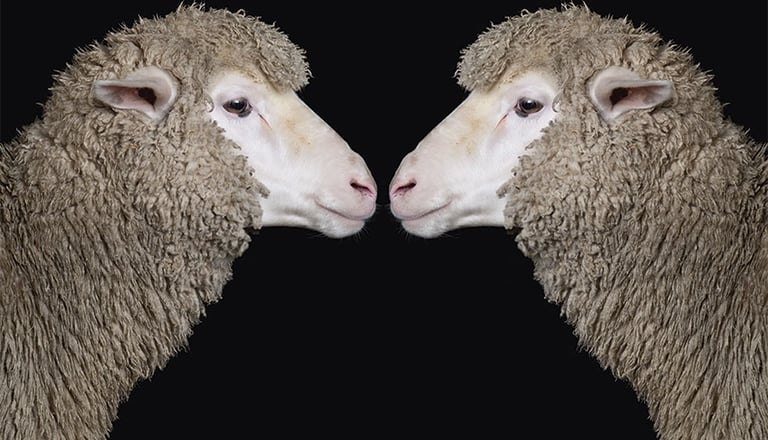
3) Reproductive cloning - aimed at replicating whole organisms. This can be done today by taking the genome from one animal and putting it into an egg that has had its original genome removed. Once the egg has developed into an early stage embryo it is then implanted into a surrogate mother where it eventually gives birth to an animal that is the same genetic makeup of the animal donating the DNA material to the empty egg. This was how the most famous cloned organism, Dolly the sheep, was created.
Many science fiction storylines over the years have touched on the concept of reproductive cloning so it is not necessarily a novel concept. What is a novel concept in the Terminal Solution Series is how the author includes the concept of peoples consciousness, emotions and essentially their soul into the cloning concept. A superior race such as the Vorranians who have mastered the ability to manipulate genetic material are demonstrating the ability to do one of a few things with their "transport tubes"
1)They can simply transport an individual by taking the energy associated with the beings essence or soul by deconstructing all their organic matter in one location and then transporting that energy to a new location and using organic matter in that location, reconstruct the being in a way to keep the individual whole and reinserting their soul and consciousness. You can see how this would be a more efficient way to transport a being light years across galaxies without needing the large amounts of energy required to move an entire physical body
2)Clone an organism similar to what we do today. However instead of taking the genetic blueprint from one individual and growing it in a surrogate mother, their expertise allows them to recontstruct a being directly into its current state as an adult orgamism. This would be a much more effective cloning process because the clone would not be exposed to years of environmental factors that could effect its development resulting in a much more similar being to the original organism being cloned.
3) Create a symbiotic relationship. Vorranians can take cloning a step further and insert the energy and soul of a Vorranian into a physically cloned body or even into the original individual. However it becomes evident that even with the Vorranians incredible expertise in manipulating genetic material and the consitution of the human body, it isn't always a smooth integration when trying to override a humans soul with their own Vorranian consciousness. As is evident on earth the human soul is what makes us truly unique among all living things on earth..... and maybe beyond.